
A Mississippi town thrust into the forefront of war
Make no mistake, the Civil War shaped the small town of Corinth, located in the northeast corner of Mississippi, thanks to a center-of-town railroad crossing. Soldiers, materials and supplies came in by rail and basically commanders believed controlling the railways meant also controlling the war. Today remnants, museums and landmarks draw visitors to explore the Civil War history and heritage of Corinth.
Bloody Civil War battles fought in Corinth and nearby Shiloh indeed left their marks on Mississippi and thrust this once sparsely populated town into the forefront of war. This area sports a number of well-done exhibits and museums that paint various pictures of life during the early 1860s.
How it all got started
The year was 1860 and the political climate both in the state of Mississippi and the nation was in rapid deterioration. Abraham Lincoln was commander in chief and the country was at war. The role of Corinth varied and ranged from a place of mobilization to a hospital center likely due to the crossing of the Memphis-Charleston and the Mobile-Ohio Railroads which was considered in 1862 to be the 16 most important square feet in the Confederacy. Today the tracks remain in those same beds.
During the war, somewhere around 300,000 troops were in the Corinth area making it the largest aggregate number of troops ever assembled in the Western Hemisphere. It was hot (hovering around 100 degrees), there wasn’t much clean drinking water and disease was rampant. Battlefields were gory and laden with blood shed by many men who were barely old enough to understand what the war was even about.
It was important to mark and explain the myriad of sites in Corinth and Old Tishomingo County that played a part in these battles both as monument and tribute. For the best experience, the Corinth Civil War Interpretive Center is the place to start.
Corinth Civil War Interpretive Center
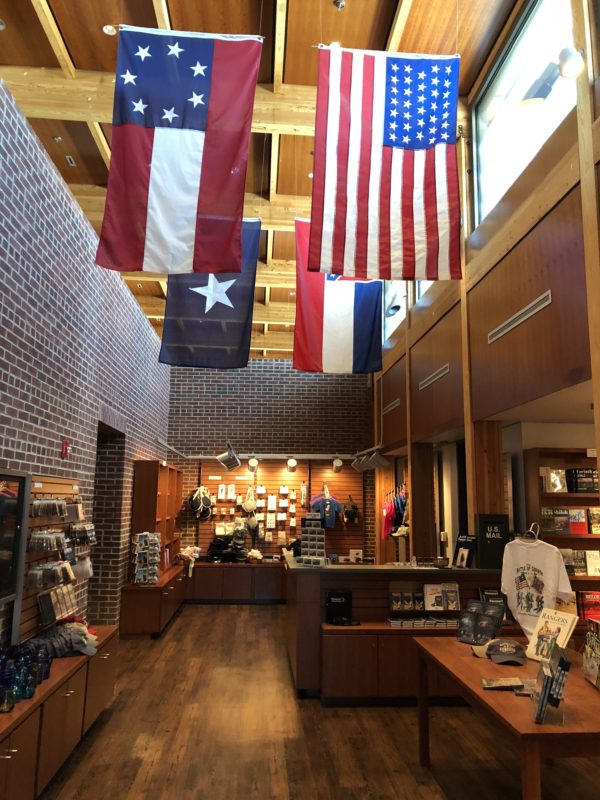
Part of the Shiloh National Park Service, the Corinth Civil War Interpretive Center is just that – a place where Civil War times is chronicled and demonstrated through exhibits and videos for better understanding and a solid foundation as a preface to touring the battlefields. (NOTE: Don’t forget to spend some time with the water feature in the courtyard.) Your walk to the entrance of the center will yield findings at your feet that might have been the same as during war times. It’s truly a world-class exhibit.
Shiloh National Military Park and Cemetery
Shiloh National Military Park, established December 27, 1894, contains many historic sites from the battlefield of Shiloh to the Siege and Battle of Corinth. Many monuments have been erected throughout the park and lots of markers are worth the stop to read. There is also the sobering Shiloh National Military Cemetery where some 4,000 soldiers were laid to rest. Additionally, the Shiloh Indian Mounds are located within the well-cared-for park as it is a well-preserved attraction for generations to come.
Corinth Contraband Camp
During the Civil War, enslaved people fled to safety behind Union lines as Federal forces occupied large portions of the South. President Lincoln’s Preliminary Emancipation Proclamation was issued in September of 1862 thereby increasing those searching for freedom in Union-occupied Corinth.
Corinth Contraband Camp was established to accommodate these refugees giving them homes, a church, a school and hospital. They farmed and sold cotton and vegetables in a coop farming program to earn a living.
Shortly thereafter, the Emancipation Proclamation was accepted and nearly 2,000 of the freed men at the Corinth Camp made up a new regiment in the Union army. Most of those men came from Alabama and the unit took on the name 1st Alabama Infantry Regiment of African Descent, later known as the 55th United States Colored Troops.
The camp was relocated to Memphis in December of 1863 where the freedmen resided in a traditional refugee facility for the duration of the war. The Corinth Contraband Camp, however, was the first step toward freedom and thus the reach for equality for many former slaves.
A portion of the Corinth Contraband Camp is preserved to commemorate the journey to freedom in 1862-1863. The property sports a quarter mile walking path with six life-size bronze sculptures erected throughout depicting men, women and children who were camp residents.
Crossroads Museum
Crossroads Museum is located in the Depot beside the iconic railroad crossing that served as a strategic transportation hub during the Civil War. Visitors can see many artifacts outlining Northern Mississippi history through permanent exhibits, railroad industry displays, fossils, American Indian artifacts and aviation memorabilia.
The Verandah-Curlee House
Built in 1857 for Hamilton Mask (one of Corinth’s founders), the Verandah House had an original Greek Revival architecture design. The house served as headquarters to several generals during the Civil War and, also as a military hospital. In post-war times, the Curlee family occupied the home on two separate occasions and eventually their descendants donated the property to the city. Today it stands a proud National Historic Landmark by the Department of the Interior thanks to its Civil War background. Additionally, it is listed on the National Register of Historic places and is a Mississippi Landmark. Many weddings are held on the grounds and in the gardens.
While Civil War history and heritage are only half the story of present day Corinth, they are important. Visiting these landmarks provides a deeper understanding of the significance that this Mississippi community played in the Civil War. Tourists can find helpful information from Corinth.net to begin their history and heritage tour of Corinth.